
Posted on: November 10th 2026
Introduction: Modernizing Author Support for Scale and Precision
Tracking a manuscript through scholarly publishing is rarely straightforward. For many researchers—particularly non-native English (ESL) scholars navigating complex English-language interface conventions and clunky submission portal UX—the process is fraught with intense anxiety. Facing opaque review windows that often stretch to six months or longer, authors are left in the dark as their articles move across submission portals, editorial offices, production queues, and open-access networks. This prolonged uncertainty causes significant stress, prompting corresponding authors, co-authors, peer reviewers, and institutional librarians to reach out with urgent inquiries spanning formatting rules, review timelines, Article Processing Charge (APC) eligibility, proof corrections, and post-publication indexing.
When support teams handle these requests in silos across fragmented systems, authors get frustrated and editorial staff end up buried in administrative tasks. Managing this workload requires a clear operational structure that matches every query with the right level of authority and context. An AI-powered author support model solves this by establishing a three-tier framework: intelligent self-service, AI-assisted case management, and expert human review. By routing each request to its ideal path while preserving complete case history, publishers can scale operations without sacrificing academic rigor or author trust.
The Author Support Challenge: Scale, Complexity, and Rising Expectations
Scholarly publishers oversee vast portfolios, each with distinct editorial guidelines, subject taxonomies, open-access mandates, and licensing options. This operational diversity creates friction across the publishing lifecycle. Authors using platforms like Editorial Manager, ScholarOne Manuscripts, or Open Journal Systems often encounter gaps between automated status updates and actual editorial activity. For instance, an accepted paper might stall in production because institutional funding under a transformative agreement needs manual verification, or a change in metadata requires updates across multiple databases.
Standard support desks typically attempt to handle these interactions through manual queues or basic chatbots. But simple tools lack access to transactional manuscript data, while manual handoffs exacerbate author anxiety through repeated transfers, lost context, and drawn-out resolution times. For ESL authors already confronting language barriers, navigating unintuitive submission platform UX and deciphering rigid support interfaces turns minor administrative checks into major hurdles, heightening the strain of already stressful six-month review windows. Unresolved dependencies quickly turn into backlogs of reopened cases. Solving these bottlenecks requires an architecture that connects core systems, enforces data permissions, and clearly separates routine informational queries from consequential editorial decisions.
The Three-Tier Framework for AI-Powered Author Support Operations
The three-tier operating model assigns incoming author requests based on query complexity, data access permissions, workflow risk, and required decision authority. Instead of forcing every inquiry through a rigid escalation chain, intelligent triage mechanisms route requests immediately to the right channel while retaining full context across every system transition.
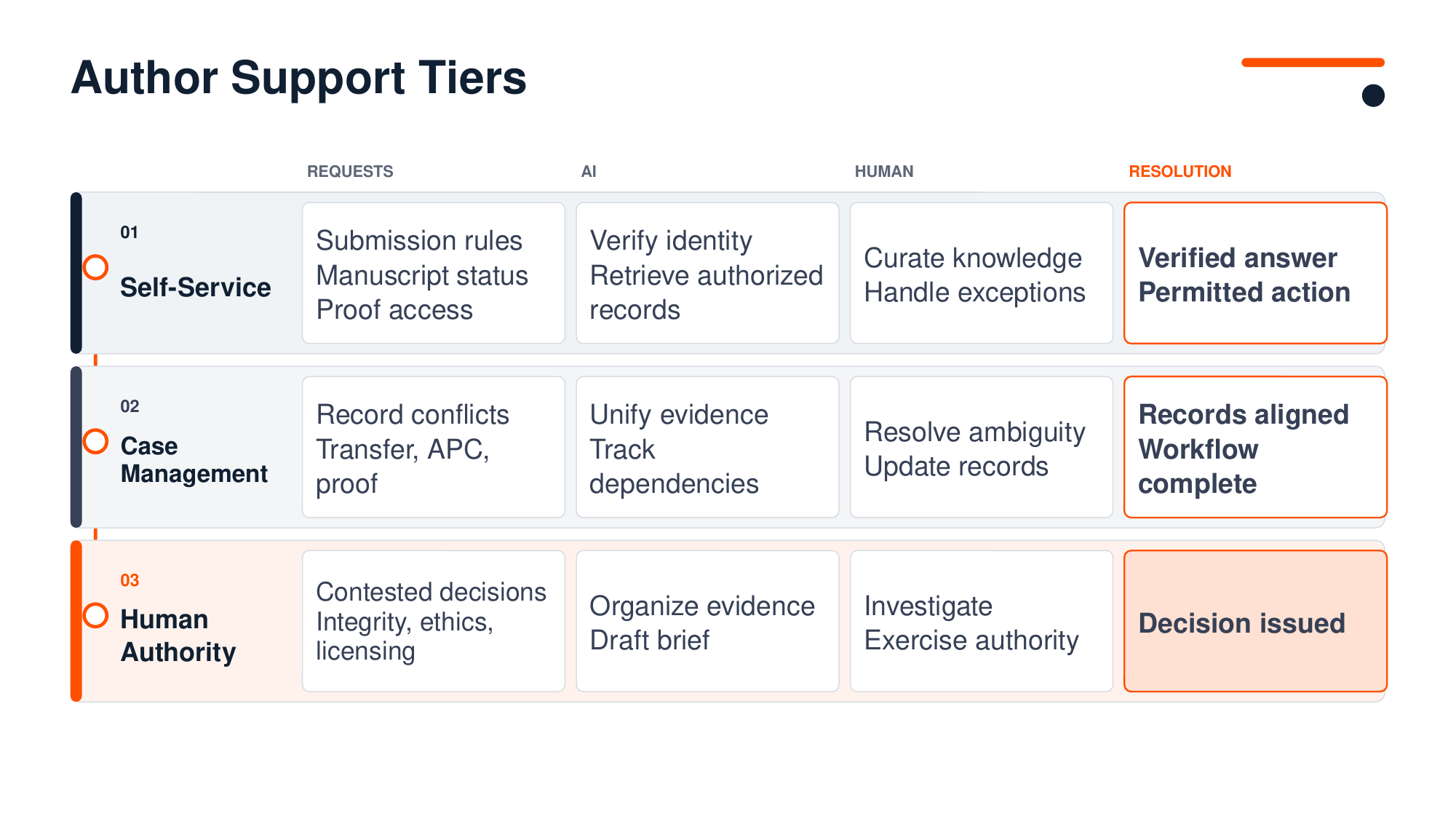
When an inquiry enters the system, intelligent triage engines analyze query context, user intent, identity, and manuscript metadata. Questions about general journal policies or verified submission statuses resolve instantly at Tier 1. Requests requiring investigation across submission and production databases route smoothly to Tier 2, where AI tools surface key case details to assist human specialists. Complex disputes or research integrity concerns bypass lower tiers entirely and go straight to Tier 3 editorial leads.
Tier 1: AI Self-Service for High-Volume Author Requests
What Tier 1 Handles
Tier 1 handles high-volume, routine requests using published documentation, public guidelines, or authorized metadata lookups. By targeting a 45–60% self-service resolution rate at Tier 1, publishers can achieve an immediate 40% reduction in status query backlogs. Common workflows include explaining manuscript preparation rules, citing formatting standards, outlining article-type requirements, offering file conversion help, and detailing standard open-access options under institutional agreements.
Core Tier 1 Capabilities
Effective self-service relies on a retrieval-grounded architecture tied directly to verified publisher knowledge bases and secure system interfaces. Grounded retrieval models search structured journal documentation to answer author questions with strict domain accuracy. When authors request status updates, authenticated APIs query manuscript systems to pull current milestone data without exposing reviewer identities or internal editorial notes.
Beyond standard information lookup, digital workers at Tier 1 can perform bounded administrative tasks under specific conditions. For example, a system can automatically re-send a secure proof access link to a verified corresponding author or check whether submitted image files meet technical resolution guidelines. By handling these tasks automatically, Tier 1 reduces support queues while providing immediate answers to authors.
Guardrails for Author-Facing AI
Deploying author-facing AI requires clear operational guardrails to prevent incorrect answers, unauthorized disclosures, or outdated policy statements. System access must match the role-based permissions established within submission platforms like ScholarOne or Editorial Manager. An author asking about a co-authored paper must complete identity verification before receiving sensitive manuscript information.
When policy guidance is ambiguous or conflicting, the system must recognize its limits and transfer the interaction to Tier 2. Rather than guessing turnaround times or APC exemptions, the system acknowledges its boundary and logs a structured case record for human specialist review.
Tier 2: AI-Assisted Case Management for Contextual Author Support
When an Author Request Escalates to Tier 2
Inquiries move to Tier 2 when resolution requires contextual analysis, cross-system validation, or coordination between departments. For authors, these situations often represent high-friction moments: confronting confusing portal UI errors, sudden status stalls, or conflicting affiliation demands. Common examples include discrepancies between status indicators and production records, failed Digital Object Identifier (DOI) registrations, or complex open-access eligibility questions where author affiliations don’t match consortium agreements.
Other Tier 2 scenarios include handling post-acceptance metadata updates, troubleshooting manuscript transfers between sister journals, and investigating delayed proof delivery. These situations can’t be resolved through automated policy lookups because they involve conflicting data across CRM systems, submission databases, and production tools.
How AI Augments Support Teams
Tier 2 blends AI efficiency with human expertise to resolve complex cases faster. Support specialists work alongside AI copilots that pull manuscript histories, compare relevant policies, review prior correspondence, and draft preliminary responses. By surfacing key case evidence and recommended next steps, the copilot eliminates manual research across disparate publisher databases.
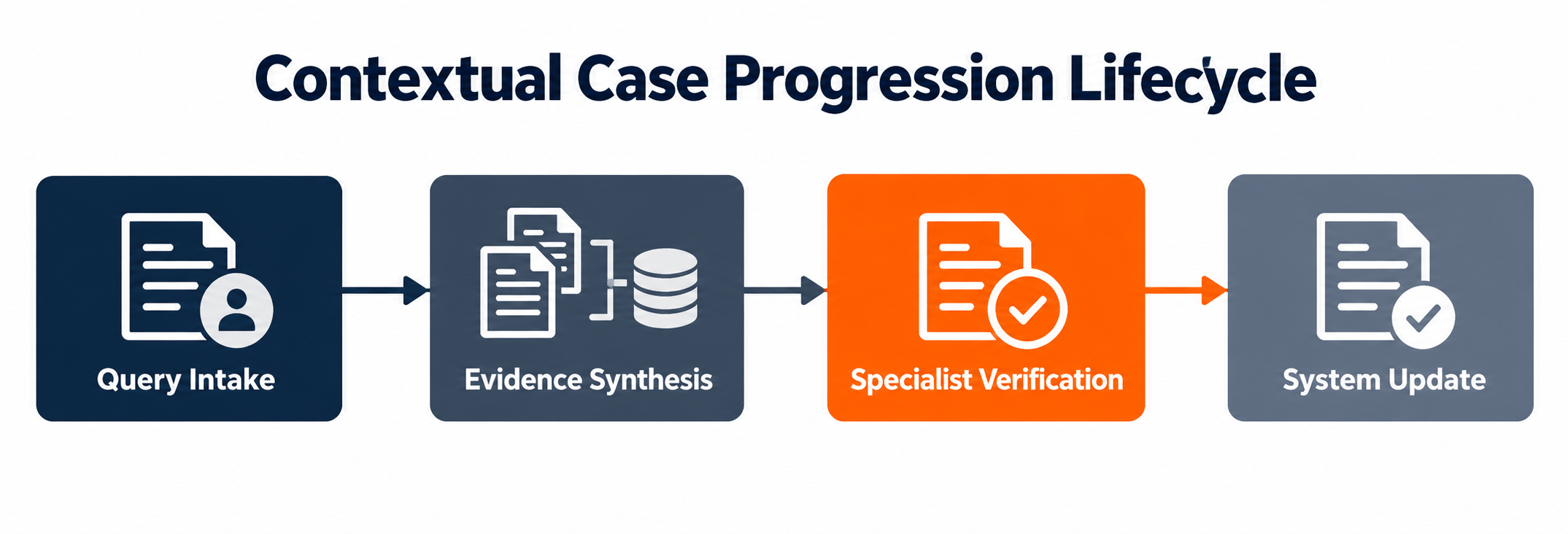
Human advisors review generated drafts, verify supporting data, and authorize all final communications. For instance, if an author questions an unexpected APC invoice, the copilot gathers institutional funding terms, submission timestamps, and email domain records. The specialist reviews the compiled brief, confirms the applicable discount, approves the waiver, and updates the billing record.
Data Integration and Workflow Design
Driving efficiency at Tier 2 requires secure, permission-aware connections across the publisher’s tech stack. Support platforms need bi-directional integration with manuscript systems, ERP billing tools, CRM databases, and production tracking systems via robust APIs.
System architecture must support durable state management, letting cases pause smoothly while waiting for external input—such as author signatures or institutional approval. Once these milestones are met, automated triggers re-engage the case, notify the assigned specialist, and present updated records without requiring manual follow-ups.
Tier 3: Human-Led Support for High-Impact Author Needs
Cases Demanding Human Leadership
Tier 3 handles sensitive, high-stakes scenarios that require expert human judgment, ethical review, legal authority, or diplomatic communication. Key examples include peer review manipulation claims, image manipulation or plagiarism allegations, authorship disputes, contested rejections, and legal challenges around copyright or licensing terms.
Similarly, Tier 3 oversees post-publication corrections, expressions of concern, retractions, and high-value financial disputes with institutional consortia. These situations carry major reputational, legal, and editorial risks that fall entirely outside automated or standardized workflows.
The Role of AI in Tier 3
While human leads retain exclusive decision-making authority at Tier 3, enterprise AI tools offer essential research and analytical support. AI agents compile chronological case histories, compare manuscript drafts against past submissions, organize reviewer notes, and cross-reference publisher ethics rules against COPE guidelines.
Before an editorial director reviews a contested rejection or authorship dispute, an AI assistant can assemble an objective summary highlighting timeline gaps, policy variances, and past communications. This preparation allows editorial leadership to focus directly on analysis and decision-making rather than manual file gathering.
Human-in-the-Loop Governance Is Essential
Governance frameworks at Tier 3 enforce strict boundaries between automated support and human authority. AI platforms are strictly prohibited from issuing binding editorial judgments, altering review outcomes, approving retractions, or modifying publishing agreements without explicit human approval.
Every action taken at Tier 3 is recorded in immutable audit trails logging the reviewer’s identity, timestamp, decision rationale, and supporting documents. This transparent recordkeeping aligns with NISO, Crossref, and COPE standards, ensuring compliance and accountability across all official decisions.
Designing the Operating Model Behind Intelligent Editorial Services
Build a Trusted Knowledge Base
A successful three-tier support model depends on a centralized, well-governed enterprise knowledge base. Scholarly publishers must systematically gather, standardize, and maintain policy documentation across all journal portfolios. This includes managing active repositories for author guidelines, editorial board structures, peer review models, open-access terms, licensing rules, and production file specs.
Knowledge management frameworks must distinguish public author guidance from internal operational procedures. Systems should monitor documentation for outdated details, flagging expired guidelines or deal terms for immediate review. When policies change, updates should push across all self-service endpoints and copilot tools simultaneously to maintain consistency.
Define Escalation, Ownership, and Service-Level Rules
Clear handoffs and ownership definitions prevent inquiries from stalling during tier transfers. Escalation logic should monitor specific triggers, such as repeated status lookups, negative sentiment, or high-risk keywords involving legal or ethical concerns. When a threshold is met, the system routes the request to a designated specialist team along with complete context.
Service-level agreements (SLAs) must distinguish between initial acknowledgment times and full resolution times. While Tier 1 self-service offers instant answers, Tier 2 and Tier 3 workflows operate under realistic, task-specific targets. Case ownership stays explicitly assigned to a named specialist or editorial lead until formal verification confirms resolution.
Start with High-Value, Low-Risk Workflows
Publishers adopting a three-tier model should begin by automating routine, high-volume inquiry types that carry minimal risk. Analyzing historical support data helps highlight recurring questions about formatting rules, status definitions, and basic open-access guidelines that unnecessarily consume specialist time.
Setting up standardized intake templates and grounded retrieval workflows for these initial use cases provides immediate workload relief. As testing confirms accuracy, consistency, and system stability, publishers can expand the framework to cover contextual Tier 2 workflows and advanced Tier 3 support tools.
Measuring the Impact of AI-Powered Author Support
Evaluating an AI-powered author support ecosystem requires looking beyond ticket volumes or chat sessions. Publishers need metrics that measure resolution quality, author effort, team efficiency, and overall economic impact across all three service tiers.
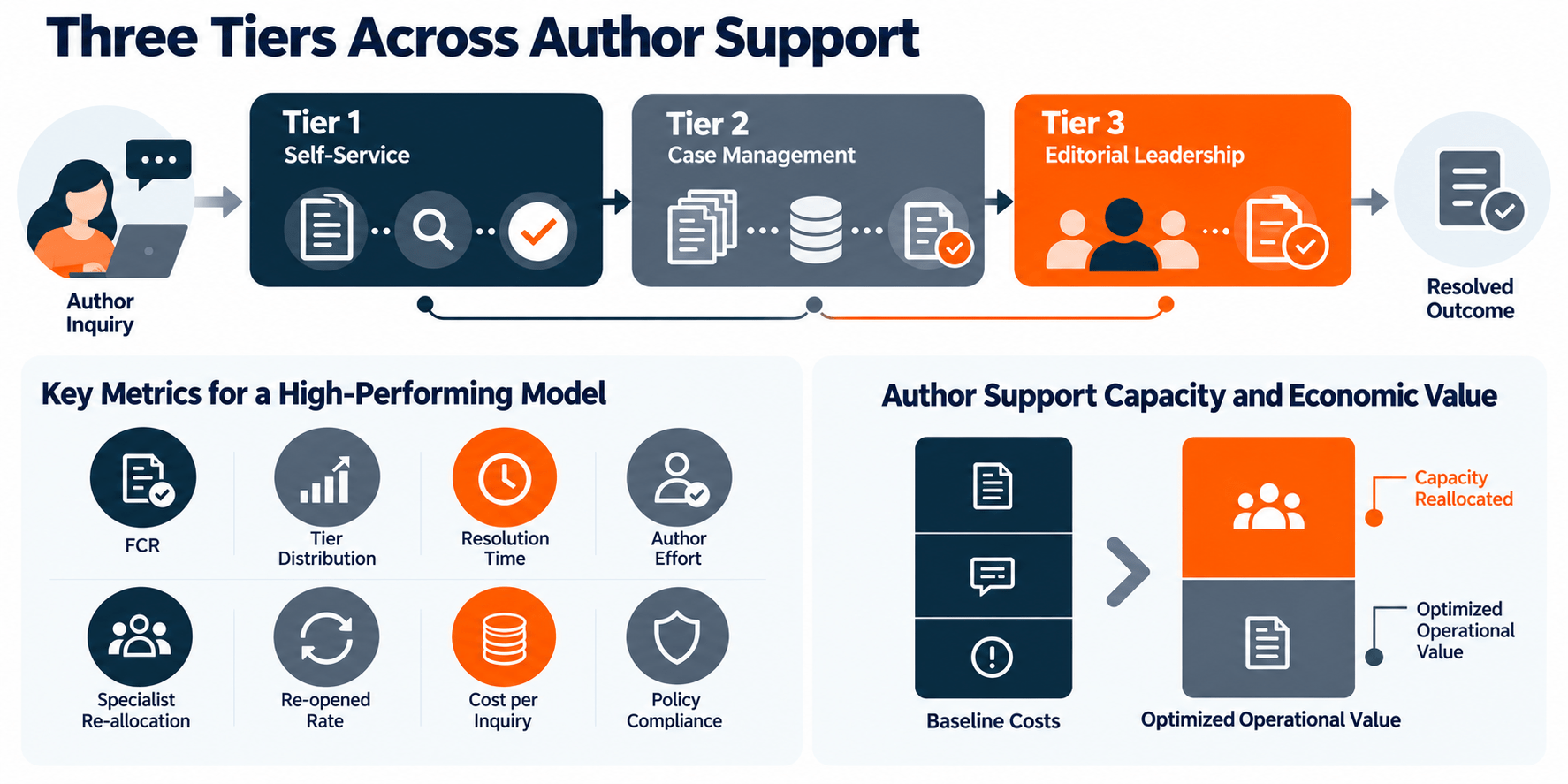
Understanding the true return on investment means looking beyond surface savings. To capture full value, publishers can evaluate progress through a practical valuation framework: Net Operational Value = (Direct Labor Savings + Unlocked Capacity Value) – (AI Platform Costs + Ongoing Governance). Benchmarks indicate that high-performing implementations routinely achieve a 30–50% reduction in average resolution time and a 25% boost in author CSAT scores:
By calculating net operational value, publishers balance direct savings from lower service costs and the unlocked value of reallocated staff capacity against initial setup and ongoing operational expenses.
Implementation Roadmap: From Pilot to Scaled Author Support Operations
Phase 1: Assess and Prioritize
The implementation journey begins with a thorough audit of support logs, query types, integration readiness, and operational bottlenecks. Publishing teams evaluate ticket volumes, resolution times, reopening trends, and handoff efficiency to pinpoint high-frequency, low-risk targets.
During this phase, project leads establish baseline metrics for first-contact resolution, cost per inquiry, and author effort scores. Defining clear resolution criteria and data governance rules ensures that early pilot phases focus on workflows with structured data and predictable outcomes.
Phase 2: Design, Test, and Govern
Phase 2 focuses on building core system integrations, configuring knowledge pipelines, and establishing role-based access controls. Technical teams connect the AI platform to manuscript submission systems, CRM software, and production databases using secure APIs.
Scenario testing validates performance across edge cases, conflicting policy situations, outdated manuscript states, and unverified user attempts. Support specialists complete training on copilot tools, evaluation protocols, and response customization. System behavior is thoroughly benchmarked against governance rules before going live.
Phase 3: Scale Through Continuous Improvement
Following successful pilot validation, publishers expand deployment across broader journal portfolios, additional languages, and more complex workflows. Continuous monitoring tracks answer accuracy, specialist adoption, response times, and author feedback.
Knowledge management teams audit documentation regularly to update policies, refine data retrieval, and optimize prompts based on real interaction logs. As self-service matures, specialist capacity shifts toward high-touch author onboarding, institutional relations, and complex case management.
Building Intelligent Editorial Services for Scholarly Publishers
Implementing a multi-tiered author support model requires combining scholarly publishing domain expertise, advanced enterprise AI architecture, and robust operational management. Publishers must ensure that technology deployments align with the unique realities of journal management, open-access mandates, and peer review ethics.
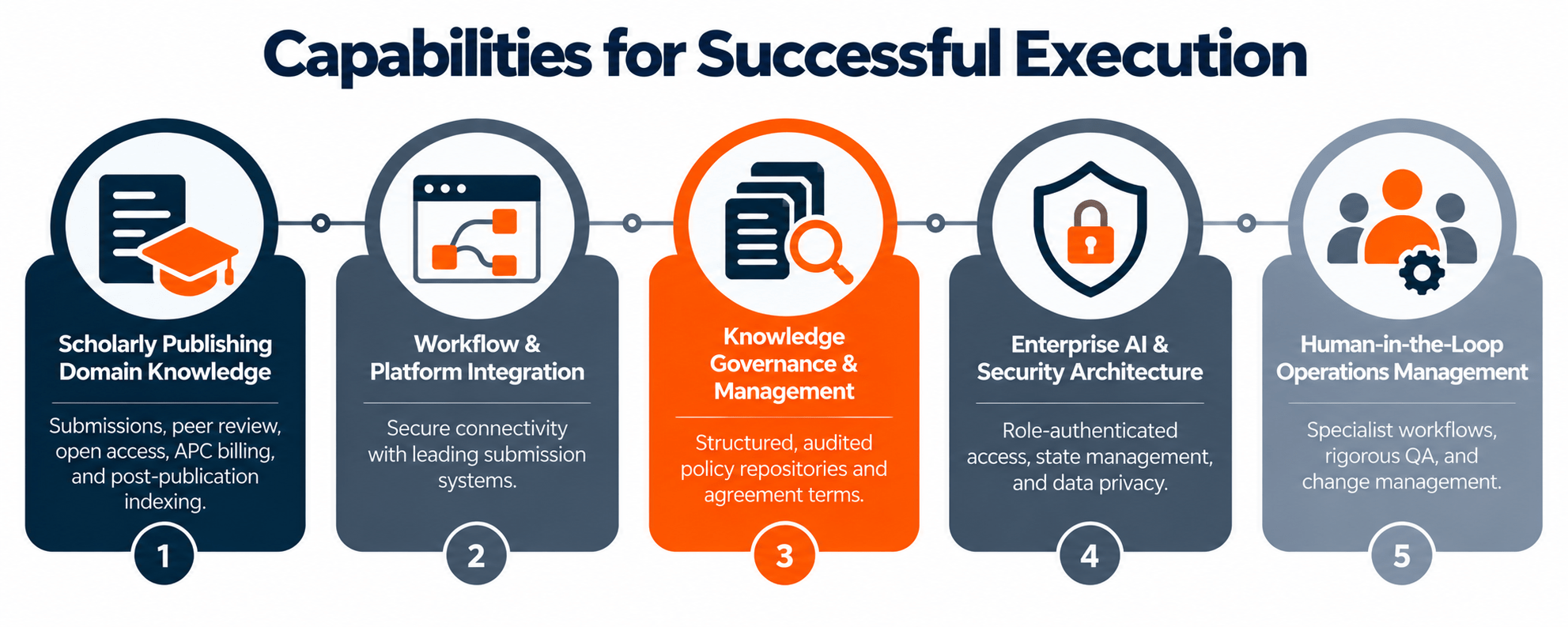
When evaluating implementation options, publishers should weigh internal development capacity against specialized external partners who bring pre-built publishing integrations, domain-trained AI models, and established operational governance frameworks.
Conclusion: Scale Author Support Without Losing the Human Touch
Deploying a three-tier, AI-powered author support framework allows scholarly publishers to handle growing inquiry volumes and operational complexity while elevating the author experience. By separating automated self-service, AI-assisted case management, and human editorial leadership, publishers ensure every inquiry receives the exact level of expertise required for accurate, efficient resolution.
This balanced operating model preserves author case context across systems, eliminates repetitive data lookup, and protects critical human editorial authority. Support teams are freed from routine tracking tasks, allowing them to focus on complex author requests, research integrity evaluations, and high-value publishing services.
Ultimately, scaling author support through intelligent automation strengthens author relationships, improves operating efficiency, and reinforces academic publishing standards. Publishers should begin by auditing inquiry patterns, building strong knowledge foundations, and deploying AI against clearly defined, measurable service goals.

SVP, Advanced Digital Solutions


