
Posted on: November 23rd 2026
AI Is Only as Good as the Workflow Behind It
Across publishing, AI is becoming part of everyday operations. Editorial teams use it to support manuscript assessment and peer review, production teams automate XML validation and quality checks, marketers enrich metadata, and rights teams accelerate contract analysis.
Yet individual applications are easier to deploy than enterprise-wide capabilities. McKinsey’s 2025 State of AI survey found that 88% of organizations use AI in at least one business function, but only about one-third have begun scaling it across the enterprise. According to Outsell’s AI Operating Priorities, AI use is becoming routine in content and editorial work, but deployment across key operating functions remains modest, with business impact still largely unquantified.
Publishers face the same gap: fragmented metadata, disconnected content repositories, and legacy production systems prevent improvements in one function from extending across the content lifecycle.
AI adoption is no longer the bottleneck. The workflow behind it is.
AI needs structured, connected, and trusted information. In a fragmented environment, it processes existing inefficiencies faster instead of eliminating them. More AI tools will not fix an unprepared operation.
The Five Signals of Unprepared Operations (and How to Fix Them)
Signal 1: Metadata Lives in Too Many Places
Editorial metadata is often spread across spreadsheets, emails, manuscript systems, production platforms, rights databases, and marketing tools. Without an authoritative source, AI cannot determine which information to trust.
For example: metadata for one title sits across disconnected systems—a manuscript-submission platform, an editorial spreadsheet, a production database, a digital asset repository, a rights-management system, and downstream distribution feeds. An author’s affiliation is corrected in the manuscript system but remains unchanged in the others. Downstream teams—and the AI systems they use—continue working with conflicting records.
To establish true readiness, publishers must replace flat metadata tables with Persistent Identifier (PID) Graph Architectures. By unifying Open Researcher and Contributor ID (ORCID), Research Organization Registry (ROR), Crossref Funder Registry, and Digital Object Identifiers (DOIs) into a graph-based single source of truth, AI systems can automatically validate relationships and keep downstream records continuously synchronized.
Signal 2: Every Exception Requires Human Intervention
Many publishing workflows still depend on experienced staff to resolve routine operational exceptions. Teams manually fix XML errors, validate metadata, route files, assign vendors, check accessibility, update project status, and verify references.
Effective publishing operations replace static decision trees with Agentic AI Orchestration. In an agentic pipeline, autonomous, single-purpose agents handle specific stages: a JATS XML Agent validates schema, hands off to an Integrity & Image Agent for forensic checks, and escalates to an Editorial Agent only when confidence falls below defined thresholds. Rules handle routine exceptions, freeing human experts to manage true ambiguity.
Signal 3: Your Workflow Stops at Department Boundaries
Publishers often optimize editorial, production, accessibility, marketing, distribution, and customer support separately. Fewer optimize the connections between them.
As content moves between functions, teams frequently recreate information instead of reusing it. Repeated handoffs turn small inconsistencies into lifecycle-wide problems. Achieving end-to-end integration requires an Event-Driven Architecture powered by real-time webhooks, APIs, and persistent metadata payloads that travel with the manuscript across every stage.
For example: when an author selects their affiliation via a ROR ID at submission, an integrated workflow automatically verifies Open Access eligibility with rights databases, opulates the production JATS XML, registers Crossref DOIs, and updates marketing channels simultaneously. Trusted information moves with the content, turning manual handoffs into continuous automation.
Signal 4: Your Content Isn’t Machine-Readable
A visually polished document is not necessarily AI-ready. AI performs best on content that is structured, machine-readable, and semantically enriched. Content without semantic tagging, structured XML, persistent identifiers, accessibility metadata, or standardized taxonomies limits what AI can reliably understand and automate.
Applying automated semantic tagging and adhering to standards such as National Information Standards Organization (NISO) Content Profile/Linked Document and World Wide Web Consortium (W3C) Resource Description Framework (RDF) specifications transforms static documents into machine-actionable knowledge graphs. The higher the semantic enrichment, the more effectively AI agents can summarize, index, and repurpose content.
Signal 5: AI Exists as Pilots Instead of Infrastructure
Many publishers point to successful AI experiments, but far fewer demonstrate enterprise transformation. AI may assist peer review, automate production checks, or generate marketing copy, but operating independently, these pilots create “AI islands.”
McKinsey’s research shows that 55% of AI high performers fundamentally redesign workflows during AI deployment, compared with only 20% of other organizations. Redesigning the operating model turns isolated use cases into scalable infrastructure.
Building an AI-Ready Publishing Operation
Transitioning from isolated pilots to scalable enterprise value requires developing five core capabilities across your content lifecycle:
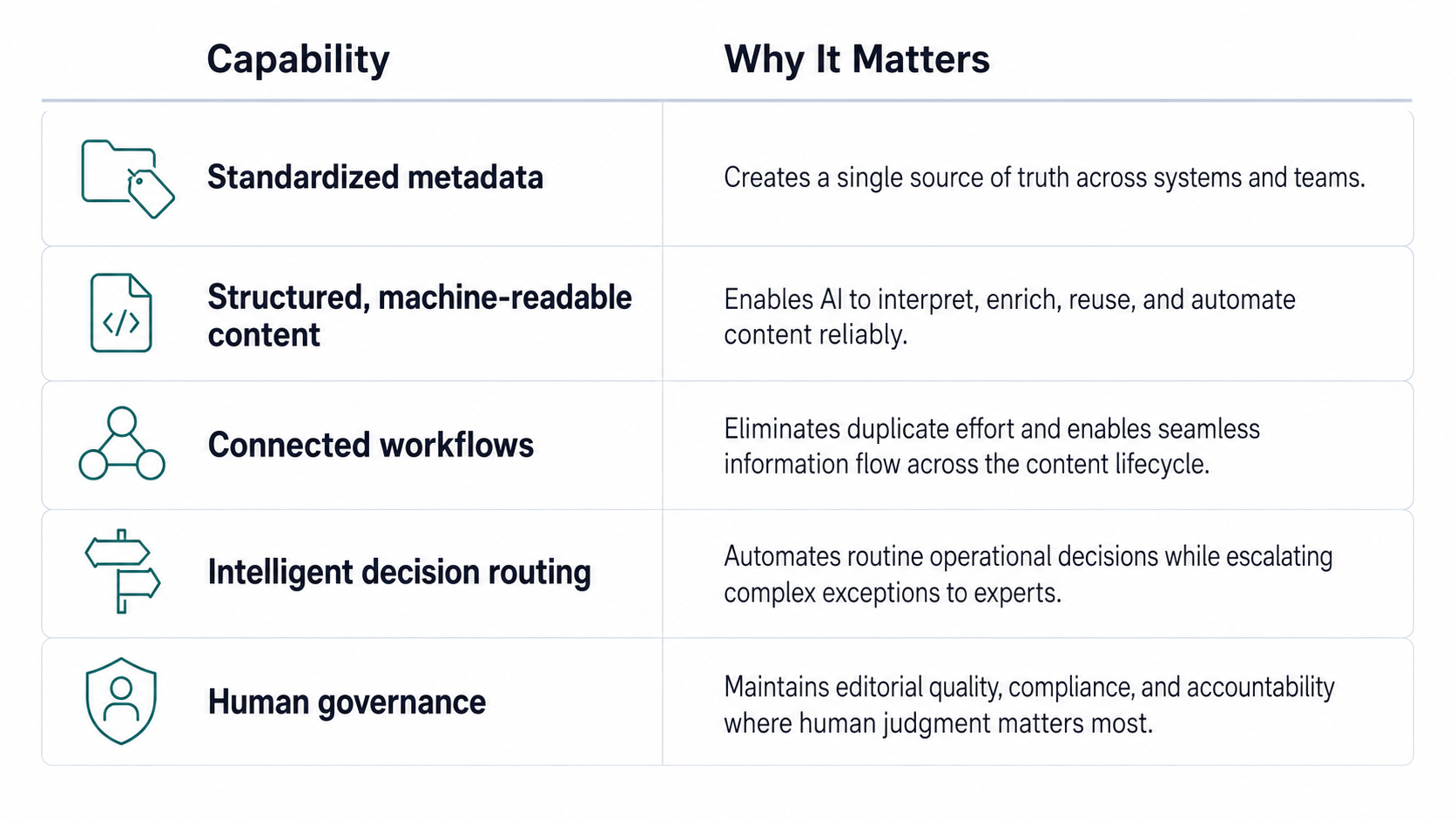
Figure 1. Five operational capabilities that help publishers move from AI pilots to enterprise-wide implementation.
Closing the AI-readiness gap starts with identifying where content, metadata, systems, and decisions disconnect. At Straive, we help publishers audit their workflows, implement graph-based metadata layers, deploy multi-agent automation, and build resilient operations where AI handles repeatable execution while experts focus on judgment and quality.

Olga Tchivikova is VP of Client Engagement at Straive and a digital transformation leader. She excels in navigating complex matrix organizations to shape customer-centric strategies that unlock measurable business value. Olga brings a proven track record of scaling global operations, leading multi-tiered teams, and managing expansive enterprise P&Ls across content operations, customer service, data management, and digital modernization.


